
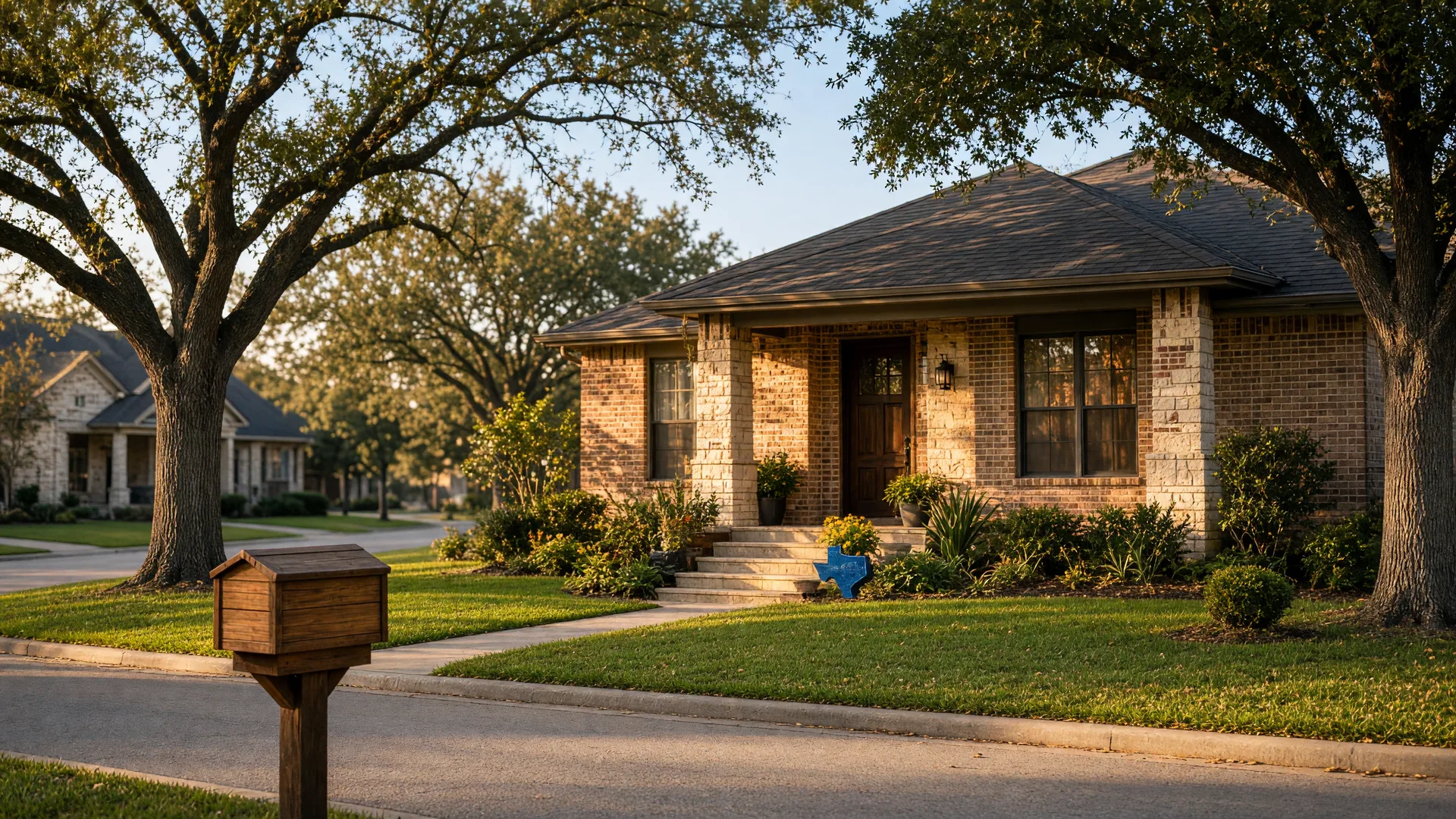
The Texas residence homestead exemption takes $140,000 off your home's appraised value for school district taxes in the 2025 and 2026 tax years, and homeowners 65 and older or disabled get a total of $200,000 off. Once it is on your home, it also caps how fast your taxable value can climb each year. In Katy, where school taxes are the largest slice of the property tax bill, the homestead exemption is the most valuable tax break most homeowners can claim, yet we still meet homeowners every year who never filed it, usually because nobody mentioned it at closing. Here is who qualifies, what it saves, and exactly how to file before the deadline.
What the homestead exemption actually does
The homestead exemption is a subtraction from your home's appraised value before your property taxes are calculated. Texas law requires school districts to provide it on a residence homestead, which is why it shows up as the biggest single deduction on most Katy tax bills. The math is simple: on a home appraised at $400,000, the $140,000 exemption leaves $260,000 of value subject to school taxes. The same exemption also unlocks benefits beyond the school district, including the appraisal cap described below.
Cities, counties, and junior college districts are not required to offer homestead exemptions, but many adopt their own smaller ones on top of the state school exemption. Katy homeowners should check their appraisal district or their annual tax bill to see which local exemptions apply to their address. To see how the full bill comes together, our property tax guide for Katy walks through every layer, from Katy ISD to the city and utility districts.
The numbers for 2025 and 2026
Texas voters approved the current figures in November 2025, and the appraisal districts applied them retroactively to January 1, 2025, so they are in effect for both the 2025 and 2026 tax years:
- $140,000 residence homestead exemption from school district taxes, up from $100,000.
- $200,000 total for homeowners 65 and older or disabled: the $140,000 base plus an additional $60,000.
- The exemption applies to one property only, your principal residence, and a household may hold only one homestead.
To put it in dollars, on a home appraised at $400,000, a homeowner under 65 pays school taxes on $260,000 instead of $400,000. A homeowner 65 or older with the same home pays school taxes on $200,000 of value. At Katy ISD's school tax rate, that difference is real money on the largest line of the bill every single year.
Who qualifies
The rules are straightforward, and they trip up more people than you would expect:
- You must own the home and occupy it as your principal residence on January 1 of the tax year.
- One homestead per household. Married couples who own a home together are entitled to one exemption between them, and you cannot claim homesteads on two properties.
- Your paperwork should match. Appraisal districts typically want a Texas driver's license or state ID showing the home as your address, and often a vehicle registration to match.
- Second homes, rentals, and business properties do not qualify. The exemption is reserved for the place you actually live.
If you close on a home partway through the year, you do not have to wait for the following January 1 to claim the exemption. Since 2022, Texas law allows a buyer who acquires a home after January 1 to receive the residence homestead exemption for the year they buy, generally for the portion of the year they own the home, depending on whether the previous owner still held the exemption on the property. That makes closing timing and the prior owner's exemption status worth a conversation with your agent, especially for buyers moving into Katy from out of state who may not know the Texas rules.
The April 30 deadline and how to file
You file with the county appraisal district where the home sits, not with the school district. The standard application is the Texas Comptroller's Form 50-114, and most appraisal districts, including Harris County and Fort Bend, accept it online. The filing window runs from January 1 to April 30 of the tax year you want the exemption for.
If you miss the deadline, all is not lost, but the rules tighten. Under current Texas law, a late application for a residence homestead exemption can generally be accepted up to two years after the tax becomes delinquent. For homeowners 65 and older or disabled, the application form also allows timely filing through the first anniversary of the date you qualify if you become eligible after January 1. Filing on time is still the smart move, because the paperwork is free and, at Katy ISD's current rate, the school-tax savings alone come to roughly $1,560 a year for most homeowners, and more for homeowners 65 and older or disabled.
Once the exemption is granted, you do not need to reapply every year in most cases. It stays on the property as long as you own and occupy it. If you sell, the exemption does not transfer to the buyer, which is exactly why new owners need to file their own application after closing.
Which appraisal district covers your Katy home
Katy sits at the junction of three counties, and the appraisal district you file with depends on which county your property is in:
- Harris County (Harris County Appraisal District): the original city core of Katy, established neighborhoods north of I-10 such as Creek Bend along Fry Road and Barkers Ridge on Barker Cypress Road, and Harris County neighborhoods south of I-10 in the 77450 corridor such as Nottingham Country, West Memorial, and Cimarron, plus parts of Grand Lakes that straddle the county line.
- Fort Bend County (Fort Bend Central Appraisal District): much of south Katy between I-10 and the Westpark Tollway, including Cinco Ranch, Seven Meadows, and other master-planned communities south of the interstate.
- Waller County (Waller County Appraisal District): the smaller far-west and northwest slice of the Katy area toward Brookshire.
The City of Katy's tax information page lists all three districts, and your most recent tax bill names the district that appraises your home. If you are not sure, ask us or ask the title company on your next transaction, and we will point you to the right office.
The 10% appraisal cap
The homestead exemption does more than subtract value, it also slows growth. Once a homestead exemption is in place, the appraised value used for school district taxes cannot rise more than 10% per year, no matter how fast the market climbs. In a market like Katy's, where values have outpaced that pace for stretches, the cap is often worth more over time than the exemption itself.
A few things to know about the cap:
- It typically begins the year after the exemption has been in place on the home.
- It limits appraised value, not tax rates, so your bill can still grow if rates go up.
- Value added by new construction is not capped, and improvements can raise your value.
- Counties, cities, and other local taxing units may add their own homestead exemption of up to 20% of appraised value on top of the school district exemption, where they have adopted one.
- The cap belongs to the owner, not the property. When you sell, the new buyer starts fresh, and when you buy, your new appraisal is based on the purchase, not the previous owner's capped value.
Extra benefits for homeowners 65 and older (and disabled)
Homeowners 65 and older or disabled get the extra $60,000 exemption on top of the $140,000 base, for a $200,000 total. They also get the most powerful protection in Texas property tax law: the school tax ceiling, often called the freeze.
Once you qualify, your school district taxes are capped at the amount from the year you first became eligible, and they cannot rise above that as long as you own and live in the home. The ceiling can be adjusted for major improvements, but normal repairs and routine upkeep do not move it. Many counties and cities offer a similar ceiling for their own taxes as a local option.
The ceiling is also portable, in a specific sense. If you move to a new home within Texas, the ceiling transfers as a percentage: the ratio of what you paid under the old ceiling to what you would have paid without it is applied to the new home's school taxes. The transfer is not automatic. You file a new homestead application with the new appraisal district and provide a ceiling-transfer form from your previous district, along with the paperwork your new district requests.
Two more groups worth knowing about: a surviving spouse age 55 or older can, in certain circumstances, continue the over-65 exemption and ceiling, and disabled veterans qualify for their own exemptions based on disability rating, with a fully disabled veteran's homestead exempt from school taxes entirely. The appraisal district confirms the exact amounts for your situation, and we are happy to point you to the right forms.
Moving within Texas: what transfers and what does not
The homestead exemption and the 10% cap do not automatically follow you to a new home. When you move within Texas, you need to:
- File a new homestead application with the new county appraisal district.
- Notify the old district so the old exemption is removed from your previous home.
- Update your Texas driver's license or state ID to the new address.
- If you are 65 or older or disabled and had a ceiling on your old home, file the ceiling transfer with your new appraisal district.
Holding two homestead exemptions, even by accident, invites questions from both appraisal districts, so make the change a closing-week task, not a someday task. If you are relocating to Katy from another Texas city, your old exemption stays behind, and the new application you file with the new appraisal district is what starts the clock on the new home.
A note on the rules
The homestead exemption is governed by Texas Tax Code Section 11.13, the appraisal cap by Section 23.23, and the over-65 ceiling by Section 11.26, with each appraisal district administering the details for its county. The numbers above reflect the current law and were confirmed against the Texas Comptroller's published figures. Nothing here is legal or tax advice, and your appraisal district is the final word on your property. If you want the conversation in plain English with someone who lives and works in this market, that is what we are here for.
Want to make sure your homestead is on file, and know what your home is worth?
The homestead exemption is free to file and, at Katy ISD's current rate, the school-tax savings alone come to roughly $1,560 a year for most homeowners and about $2,230 for homeowners 65 and older, but only if it is actually on the books. If you are not certain yours is filed, we can help you figure out which appraisal district to call and what to bring. And while we are at it, we can pull a market-informed valuation of your home so you know exactly where you stand in today's market. Call Carol at (832) 212-2772 or send a note through the contact page. No pressure, no obligation, just straight answers.