
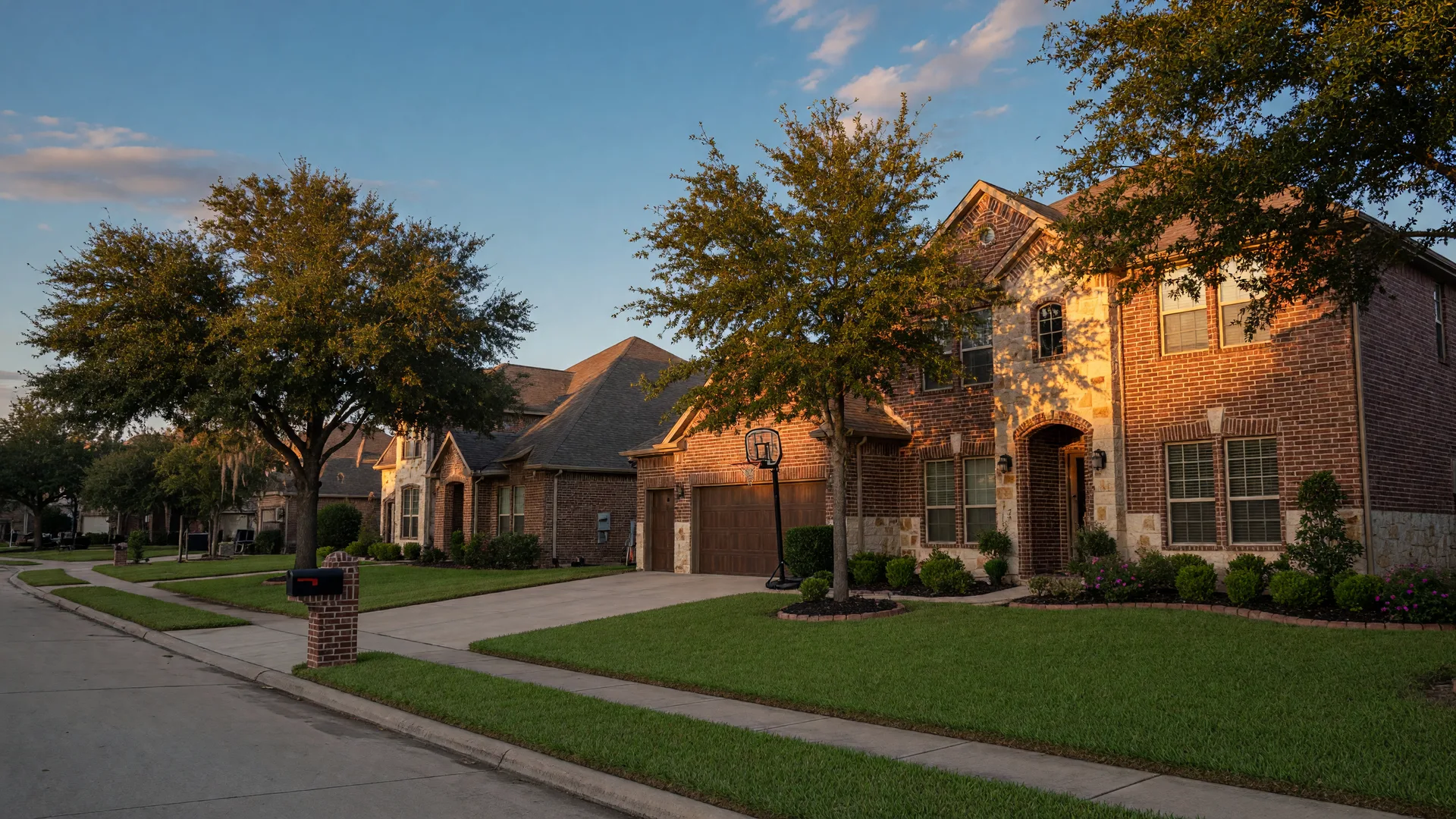
How much are property taxes in Katy, Texas? For the 2026 tax year, Katy ISD's rate is $1.1171 per $100 of assessed value and the City of Katy's rate is $0.42, with county and special district layers sitting on top of both. On a home near Katy's median price of about $385,000, the school district's share of the bill alone comes to roughly $2,737 a year after the $140,000 school homestead exemption, and the full bill is usually several thousand dollars more once county, city, and utility district taxes are added.
Texas has no state income tax, which is a big part of why property taxes matter more here than in most states: local real estate taxes carry a large share of the funding for schools, roads, and emergency services. So whether you are buying, moving to the area, or just trying to read your annual bill, here is how Katy property taxes actually work, with the current rates and the rules that shape them.
Who taxes a home in Katy: the four layers
A Katy property tax bill is not one tax. It is a stack of separate levies, each set by a different local government, each quoted as a rate per $100 of assessed value, and each appearing on the same annual bill:
- The school district. Katy ISD is the biggest line on almost every bill in the area, and it is the rate most people quote when they talk about "the Katy tax rate."
- The county. Katy ISD spans parts of Harris, Fort Bend, and Waller counties, and each county levies its own rate.
- The city. The City of Katy tax applies only to homes inside the city limits, and much of what is sold as "Katy" is not inside them.
- Special districts. Municipal utility districts (MUDs), drainage and flood-control districts, and hospital districts add their own levies. These do the heaviest lifting in newer master-planned communities, where the infrastructure was built by the developer and is paid off through the MUD over decades.
One of the most common surprises for newcomers is that "Katy" the city and "Katy" the school district are very different boundaries. Katy ISD covers a huge footprint that takes in most of Cinco Ranch, Elyson, Grand Lakes, and other communities that sit outside the City of Katy limits, mostly in unincorporated Fort Bend or Harris County. Homes there pay no city tax, but they usually sit in a MUD that adds its own line. Our Katy community guide maps this out, and the Cinco Ranch guide is a good example of how the unincorporated math works in a large master-planned community.
Katy ISD: $1.1171 per $100, unchanged for a third year
Katy ISD's board adopted the FY 2026-27 rate of $1.1171 per $100 on September 21, 2026, holding it flat for the third consecutive year. The rate splits into a maintenance and operations (M&O) portion of $0.7271, which funds day-to-day school operations, and an interest and sinking (I&S) portion of $0.3900, which pays down voter-approved debt on buildings and infrastructure.
Here is the math the school portion of a real Katy bill follows. Take a home appraised at $385,000, close to Katy's July 2026 median price. Subtract the $140,000 school homestead exemption, and the taxable value for school purposes is $245,000. At $1.1171 per $100, the Katy ISD share comes to about $2,737 a year.
The $140,000 school homestead exemption and what it saves you
Texas voters approved Proposition 13 in November 2025, raising the residence homestead exemption for school taxes from $100,000 to $140,000 for the 2025 tax year and later. Homeowners age 65 and older or disabled get $200,000 (the $140,000 plus a $60,000 add-on). The exemption is set by state law and applies in every Texas school district, including Katy ISD, so there is no extra local filing beyond your homestead application.
It is a meaningful number. On that same $385,000 example, the increase from $100,000 to $140,000 alone drops the Katy ISD portion by about $447 a year, roughly $37 a month, and that saving repeats every year you own the home.
City of Katy: $0.42, but only inside the city limits
The City of Katy adopted a $0.42 per $100 rate for 2026 at its September council meeting, a small reduction from the prior year's $0.425 and tied to its FY 2026-27 budget. The city also grants a 20% residence homestead exemption (minimum $5,000) on its portion of the bill.
On a $385,000 home inside the city limits, the city line would run about $1,294 a year after that exemption. But remember: most Katy addresses in master-planned communities are not inside the city limits, so they have no city line at all. Their trade-off is a MUD line that can rival a city bill. This is why two similar Katy homes a few miles apart can have very different totals, and it is worth asking about before you fall in love with a neighborhood, not after.
County and special district layers: the part of the bill that varies most
The county layer follows whichever county the home sits in. Using each county's most recently published own-levy rates (2025 tax year figures), Harris County is roughly $0.49 per $100, Fort Bend County about $0.42, and Waller County $0.556187. On our $385,000 example, the county share alone is roughly $1,620 to $2,140 a year before county exemptions.
Putting the layers together: the school, city (where it applies), and county portions of that $385,000 home add up to roughly $4,400 to $6,200 a year, depending on the county and whether the home is inside the City of Katy. Then MUDs and other special districts add their own levies. Katy ISD rates are consistent across the district, but the rest of the bill is local, neighborhood by neighborhood. When you tour, it is fair to ask for the current tax bill on any home you consider, and we pull those records on every property we show.
The 10% appraisal cap: the rule most owners underuse
Once a home is your residence homestead, Texas law caps how fast its appraised value can climb. Under Tax Code Section 23.23, the appraised value used for taxes cannot rise more than 10% per year over the prior year's appraised value, plus any new improvements, even if market value jumps far more. The cap takes effect the year after your homestead exemption is on file, and it resets when ownership changes: a new buyer's cap starts the year after they first qualify for the exemption on that home.
This matters in two directions. Longtime owners in fast-appreciating Katy neighborhoods often owe taxes on a capped value well below market, which is a quiet form of protection. Recent buyers who purchased during the 2021 to 2023 run-up should expect their capped value to start near their purchase price and grow from there. Either way, filing your homestead exemption promptly is one of the highest-value moves a Texas homeowner can make, and if the appraisal district's value looks high, you can protest it. The deadline is May 15 or within 30 days of the district's notice of value, whichever is later.
When the bill arrives and how it gets paid
Texas appraisal districts mail tax bills in October, and the full payment is due January 31 of the following year (when that date falls on a weekend, the deadline moves to the next business day). Most homeowners with a mortgage never see the bill as a lump sum: the lender collects roughly one-twelfth of the estimated annual tax each month into escrow and pays it for you. If you own free and clear or escrow is not in place, Texas offers a split-payment option, with the first half due November 30 and the second half June 30.
For buyers, the practical lesson is to budget the tax into the monthly cost of the home you are considering, not just the principal and interest. Two homes at the same price in different Katy suburbs can differ by hundreds of dollars a year, and that difference is part of the real cost of owning.
What this means when you compare Katy neighborhoods
Katy ISD's rate is one figure, but the bill is local. When you compare neighborhoods, look at the full picture for each area: county, city or MUD coverage, bond debt on older versus newer subdivisions, and how the appraisal cap applies to your first few years of ownership. The Market Snapshot page tracks prices and inventory month by month, and our Katy homes guide walks through how communities differ. The tax records for a specific home are the final word, and we can pull those for any address you are watching.
A note on the numbers
The rates above are the most current published at the time of writing: Katy ISD's FY 2026-27 rate, adopted September 21, 2026; the City of Katy's adopted 2026 rate, posted September 2026; county rates from the 2025 tax year notices from the Harris County Tax Office, Fort Bend County, and Waller County; and exemption rules from the Texas Comptroller's property tax pages. The $385,000 illustration uses Katy's July 2026 median price from Houston Association of REALTORS data. Rates are re-adopted every year, appraised values move, and every home's bill is its own, so treat these as a guide and verify the real numbers for any specific address before you commit.
Want the real tax picture for a home on your list?
Property tax is a line you will live with for as long as you own the home, so it deserves the same attention as the price and the floor plan. Before you make an offer, ask us for the tax history and current bill for any Katy home you are considering, including how the homestead exemption and the 10% cap apply. Call Carol at (832) 212-2772 or send a note through the contact page, and we will pull the numbers for you, no obligation. If you are comparing areas before you even tour, tell us which neighborhoods are on your list and we will break down how the layers differ for each one.