
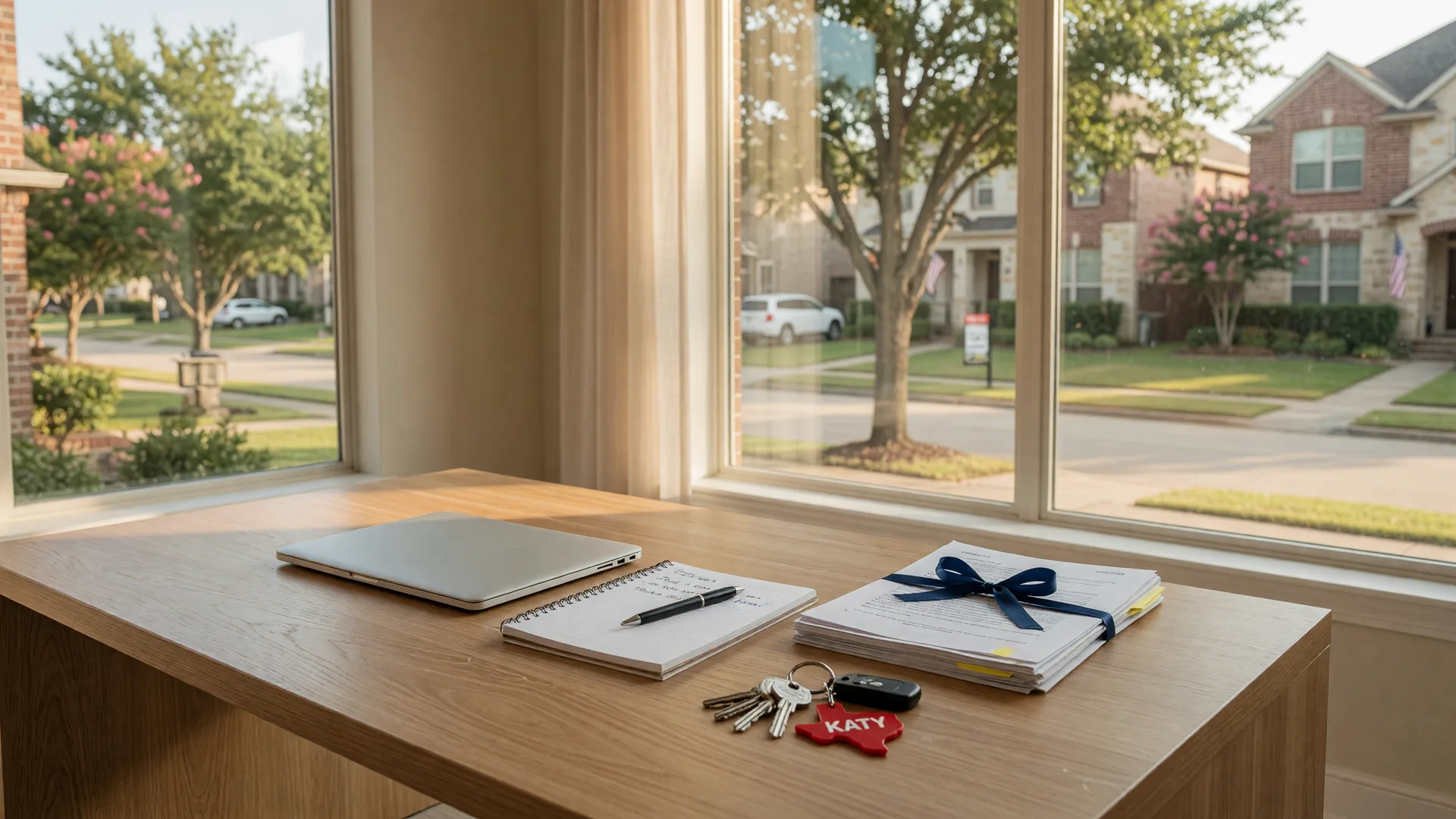
To become a licensed real estate sales agent in Texas in 2026, you complete 180 hours of TREC-approved qualifying education, file an application with the Texas Real Estate Commission (TREC), pass a fingerprint background check, pass the state licensing exam, and then have a sponsoring broker activate your license. The education is the longest step, and the license only starts working once a broker sponsors you, because every Texas sales agent must work under a licensed broker.
Texas licenses a lot of real estate agents, and the process is the same whether you plan to sell homes in Katy, Houston, or anywhere else in the state. The rules come from TREC and the Texas Real Estate License Act, and they change over time, so the most reliable habit is to check TREC's own website before you pay for anything. What follows is the path as it stands today: the courses, the exam, the fees, the sponsorship step, and what happens at your first renewal and beyond.
The Texas licensing path at a glance
The road from "thinking about it" to "licensed and active" looks like this, in order:
- Complete 180 hours of TREC-approved qualifying education (six specific 30-hour courses).
- File your sales agent application in TREC's online portal and submit to a fingerprint background check.
- Pass the national and state portions of the Texas licensing exam with Pearson VUE.
- Have a sponsoring Texas broker request activation of your license. Until a broker sponsors you, the license sits inactive.
- Complete apprentice education requirements before your first renewal, then renew every two years with 18 hours of continuing education.
You must be at least 18, a United States citizen or lawfully admitted alien, and meet TREC's standards for honesty, trustworthiness, and integrity to qualify. Those are the gate: if any part of your background raises a question, TREC reviews it as part of the application.
Step 1: the 180 hours of education, and the six courses that make them up
Every Texas sales agent applicant must complete six TREC-approved qualifying courses of 30 classroom hours each, for 180 hours total. There are no substitutions, so the list matters:
- Principles of Real Estate I and Principles of Real Estate II, the two foundations courses that cover ownership, contracts, finance, valuation, and brokerage basics;
- Law of Agency, the legal relationship between agents and their clients, including disclosures and duties;
- Law of Contracts, how contracts are formed, performed, and breached;
- Promulgated Contract Forms, the standard Texas Real Estate Commission forms, including the residential purchase contract you will use daily;
- Real Estate Finance, mortgages, lending, and the math of a real estate transaction.
You can take these in person or online through any TREC-approved education provider, and providers set their own prices and schedules. In the Katy and Houston area, that means you have a genuine choice between classroom settings and live online courses; either satisfies the requirement as long as the school is TREC-approved. Expect the coursework itself to run roughly $500 to $1,000, depending on the provider and whether you buy courses in a bundle.
Step 2: the application and the background check
Once your 180 hours are complete, you file your sales agent application through TREC's online REALM portal and upload your course completion certificates. The application fee is about $206, which combines the base application fee with Texas Online and other statutory fees, and an approved application stays valid for one year. If you do not finish the process in that window, you reapply.
Along with the application comes a fingerprint background check, done through IdentoGO by IDEMIA at a cost of about $37. This is not a formality: TREC reviews criminal history as part of its honesty and trustworthiness standard, so if you have a record that might raise questions, it is worth doing your own homework on eligibility before you spend money on the education. TREC's website publishes guidance on how it evaluates criminal history.
Step 3: the licensing exam through Pearson VUE
After TREC approves your application, you schedule the licensing exam with Pearson VUE and pay the exam fee, currently about $58 per attempt at the time of writing, when you schedule. The exam has two portions: a national section and a Texas state section, and you must pass both. Every state with a real estate license has its own rules, so if you already hold an active license in another state, Texas offers a process to evaluate whether your education and exam history transfer before you start over.
Most applicants retake a portion at least once, which is normal and not a reflection on anyone. The exam tests the same material as the 180 hours, so thorough course work is genuinely the best preparation.
Step 4: sponsorship, the step people forget until the end
Here is the part of the Texas system that surprises most newcomers: passing the exam does not put your license to work. A Texas sales agent license only becomes active when a licensed Texas broker requests activation on your behalf, because every sales agent must work under a sponsoring broker who holds responsibility for their transactions. Until that happens, your license sits in inactive status.
That makes choosing your brokerage a licensing decision, not just a career decision. The broker you sign with becomes the party legally responsible for your work, so the quality of that broker matters to your license, your training, and every deal you close. This is exactly why we built Realty Pros of Texas the way we did: a broker-led office where agents get direct access to the broker, twice-monthly training, and real transaction support instead of being left to figure things out alone. If you are interviewing brokerages, our why-join page lays out what we believe agents deserve, and the support and training page shows what your first months would actually look like here.
Step 5: apprentice education before your first renewal
Texas does not stop at the 180 hours. Under the Sales Apprentice Education (SAE) rules, you must complete 90 additional hours of qualifying education before your first license renewal, including the 30-hour Real Estate Brokerage course, plus the Legal Update I and II courses. By the time your first two-year term ends, you will have completed 270 total hours of qualifying education. It sounds like a lot, and it is: Texas deliberately built this system so that a new agent's first term is one long apprenticeship under their broker.
After that: 18 hours of continuing education every two years
Once you clear the apprentice stage, renewals settle into a steady rhythm. Texas real estate licenses renew every two years, and each cycle requires 18 hours of TREC-approved continuing education: 4 hours of Legal Update I, 4 hours of Legal Update II, 3 hours of contract-related coursework, and 7 hours of elective topics. Brokers carry an additional requirement: a 6-hour Broker Responsibility course, which TREC requires all renewing brokers to take effective January 1, 2026, whether or not they sponsor agents.
Renewal is not something to cram. TREC gives you time to spread the 18 hours across the cycle, and the courses are practical: legal updates track rule changes from the past two years, which in Texas real estate is never a quiet stretch.
How long does it take, and what does it cost?
The common question is a timeline. The education is the longest step, and it depends entirely on your schedule and your provider's calendar: some applicants finish the 180 hours in a matter of weeks of full-time study, while part-time students commonly spread it over several months. Add the application review, the exam, and the sponsorship paperwork, and a realistic plan is usually measured in months rather than weeks, with most of the variable being how fast you move through the courses.
On cost, a reasonable budget for the basics is roughly $800 to $1,300: $500 to $1,000 for the coursework, about $206 for the application, about $37 for fingerprints, and about $58 per exam attempt, with retakes adding to the total. Trumpeted prices vary by provider, so get the full cost in writing before you enroll, and confirm that the school is listed as TREC-approved on TREC's website before you pay.
Where the path leads: the broker's license
Sales agents work under brokers, and many experienced agents eventually take the broker's exam themselves. Texas makes the broker's license a genuine standard: you need an active Texas license, four years of active practice within the five years before you apply, qualifying transactions in at least four of those five years, a total of 720 experience points, and a stack of classroom hours (900 hours in total, including 270 hours of qualifying courses and the mandatory Real Estate Brokerage course, which must be completed within two years of applying), followed by the broker exam.
Carol Jukes is a living example of the long game. She leads Realty Pros of Texas and mentors the agents who join her. Her full bio covers the designations and the background, but the part that matters for someone starting out is simpler: the broker you train under shapes the agent you become, which is why she treats mentoring and brokerage culture as core work, not an afterthought.
The honest version: what nobody tells you before you start
Getting licensed is achievable, but it is only the first step, and the licensing process does not teach you how to find clients, price a listing, negotiate a repair request, or survive the months when no paycheck is coming. New agents in Texas commonly underestimate three things: the cost of running a real business (MLS dues, association fees, errors-and-omissions insurance, marketing), the irregular income of commission work, and how much the supervising broker's training matters. None of that should stop you, but it should shape how you choose a brokerage. Look for the office that will actively train you in the first two years, because Texas has already built that expectation into the apprentice rules, and the brokerage you choose should live up to it.
A note on the numbers
The requirements in this article come from the Texas Real Estate Commission: the "Become a Real Estate Sales Agent" and "Become an Individual Real Estate Broker" pages on trec.texas.gov, TREC's published fee schedule, and the Texas Administrative Code sections that govern education and experience (22 TAC §535.56 and §535.65), all current as of October 2026. Fees and rules are set by TREC and can change, so treat the dollar figures as this month's snapshot and verify the current amounts on TREC's website before you commit. If anything in this article conflicts with TREC's current published guidance, TREC wins.
Talk to a broker who has done the job
Research will only get you so far. If you are seriously considering a Texas real estate license, the most useful next step is a conversation with a broker who actively mentors new agents. Carol Jukes is happy to answer your questions straight: what the education is really like, what the first year of commission income looks like, what matters when you compare brokerages, and whether Realty Pros of Texas is the right fit for your goals. Call her at (832) 212-2772, or start with a confidential conversation with the brokerage. No pitch and no pressure, just an honest look at the career.